István Láng - Laudate Hominem Cantata / Chamber Cantata / Musica Funebre / Monodia Per Clarinetto Solo / Quartetto D'archi No. 2 download mp3 flac
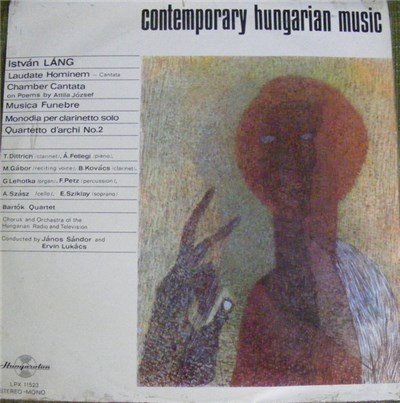
Performer:
István Láng
Title:
Laudate Hominem Cantata / Chamber Cantata / Musica Funebre / Monodia Per Clarinetto Solo / Quartetto D'archi No. 2
Country:
Hungary
Genre:
Classical
Style:Contemporary
Released: 1971
Catalog number: LPX 11523
Label: Hungaroton
MP3 album szie: 2408 mb
FLAC album size: 2883 mb
Tracklist
| Laudate Hominem (Kantáta Három Részben / Cantata In Three Parts) | (27:03) | |
| A1a | I. Nenia | |
| A1b | II. Parte Principale | |
| A1c | III. Epilogo | |
| Kamarakantáta József Attila Verseire, Énekhangra És Kamaraegyüttesre / Chamber Cantata On The Poems By Attila József, For Voice And Chamber Ensemble | ||
| A2a | I. Miben Hisztek... / In Whom Do You Believe... | |
| A2b | II. Kopogtatás Nélkül... / Without Knocking... | |
| Musica Funebre Per Orchestra (Gyászzene Zenekarra / Funeral Music For Orchestra) | (29:59) | |
| B1a | I. Silenzio | |
| B1b | II. Epitaffio | |
| B1c | III. Double | |
| B1d | IV. Inno ( In Forma Di Bar) | |
| B1e | V. Esaltazione | |
| B1f | VI. Consolazione Nel Dolore Grande | |
| B2 | Monodia Per Clarinetto Solo In Si | |
| Quartetto D'archi No. 2 (Il. Vonósnégyes / String Quartett No. 2) | ||
| B3a | I. Allegro Fuoco E Ben Ritmico | |
| B3b | II. Allegretto Giocoso | |
| B3c | III. Adagio Molto | |
| B3d | IV. Allegro Agitato |
Credits
- Cello – Árpád Szász (tracks: A2)
- Choir – Choir Of The Hungarian Radio And Television (tracks: A1)
- Clarinet – Béla Kovács (tracks: B2), Tibor Dittrich (tracks: A2)
- Composed By – István Láng
- Conductor – Ervin Lukács (tracks: B1), János Sándor (tracks: A1, A2)
- Design – Endre Bánó
- Engineer [Recording] – János Lukács
- Orchestra – Orchestra Of The Hungarian Radio And Television (tracks: A1, B1)
- Organ – Gábor Lehotka (tracks: A1)
- Percussion – Ferenc Petz (tracks: A2)
- Piano – Ádám Fellegi (tracks: A2)
- Producer – Dóra Antal (tracks: B3), István Juhász (tracks: A1,2; B2;)
- Soprano Vocals – Erika Sziklay (tracks: A2)
- Strings – Bartók Vonósnégyes (tracks: B3)
- Voice [Reciting] – Gábor Miklós (tracks: A1)
Notes
A1a - Nenia (Elképzelt Siratóének Az Emberiség Tagolatlan Beszédű Korából / Imaginery Lament From The Age When Mankind Was Inarticulate)A1b - Parte Principale (Sophokles: Antigone, 2. Kartétel Trencsényi Waldapfel Imre Fordítása Nyomán / Sophokles: Antigone, 2nd Choral Movement, After The Translation By Imre Trencsényi Waldapfel)
A1c - Epilogo (József Attila: "Levegőt" c. versének utolsó három sora / Last 3 Lines of the Poem "Air" by Attila József)
A tasakon: Vajda Lajos: Önfelmutató önarckép
On the cover: Self exhibited portrait by Lajos Vajda
István Láng (b. 1933), an outstanding talent among presentday Hungarian composers, studied at the Budapest Academy Of Music as a pupil of János Viski and then of Ferenc Szabó. Since 1958, he has been occupied with new musical trends, and during the last decade, many of his modern orchestral and chamber compositions have been featured in the programmes of European concerts and radio stations. For years he has also been the music director of the State Puppet Theatre.
This recording presents a cross-section of István Láng’s compositions originating from the years between 1962 and 69. The earliest is the Chamber Cantata for soprano solo and four instrumentalists. It is based on two poems by Attila József, the great Hungarian proletarian poet who was active between the two world wars („In Whom Do You Believe”, „Without Knocking”). Both are love poems, the first expressing the cosmic suffering of unfulfilled love, and the second the happiness of warm love, even in poverty. This composition contains a whole range of stylistic features characteristic to Láng’s art. The forceful, animated melody, broken by agitated gestures and a melismatic vocal part, also appears, in new interpretations, in the best of his instrumental pieces. Chronologically the following work is MONODIA PER CLARINETTO SOLO , originally composed as ballet music. Here Láng further developed the creative technique applied in the Chamber Cantata. The composition’s fibre, rich in contrasts, and its expressive gestures unfold from one single motivic germ. The STRING QUARTET is more complex and of a more elaborate structure than the two above mentioned works. In one single movement – actually divided into seven sections by an accumulation of microstructures – the composer encompasses the form and content of a classic string quartet on the one hand, and expresses the turbulent atmosphere of our age, on the other. The four main sections are linked by cadenzas.
LAUDATE HOMINEM, composed in 1968, and MUSICA FUNEBRE, completed in 1969, are related to one another and to the chamber works reviewed above. Both compositions commemorate the victims of fascism. The expressive forceful melody rising above the now static, now dynamic plane of tonality, and the strictly compressed musical form link these two conceptionally related works to the earlier chamber music compositions. Musica Funebre is divided into six sections: Silenzio is a single resigned crescendo-decrescendo; the woodwind dialogue in Epitaffio is more personal in tone; the foregoing music is summed up in a variative manner in Double; Inno is the only fast movement in the composition, with the melody played on the trombone moving in close intervals and radiating an almost Bizantine atmosphere, heard throughout; after the staggering intensification and powerful emotional outburst of Esaltazione, the last movement, Consolazione nel dolore grande closes the composition by expressing slowly subsiding passion.
The orchestra in Laudate Hominem does not include clarinets, horns, violins or cellos, that is soft „sentimental” instruments. The composition consists of three sections. The opening movement, Nenia, expresses the inarticulate, primeval suffering of mankind. The chorus only utters vovels and consonants. The middle section, Parte principale, is the apotheosis of man in an excerpt taken from the famous chorus of Antigone by Sophokles. The four, and then eight part choral movement constructed with strict contrapuntalism and enclosed by an instrumental framework, equally expresses emotion and intellect. The strongly rhythmic chorus lends a background and at the same time an interpretation to the narrator’s declamation. After a lengthy organ solo, the Epilogo is a calm and quiet revelation. The chorus in quoting the last lines of Attila József’s poem „Air”, praises freedom and order. Thus the dramatic structure of the composition leads from inarticulate emotions to a suitable musical expression of an order worthy of man. (János Breuer)
Companies
- Printed By – Kossuth Nyomda
Related to István Láng - Laudate Hominem Cantata / Chamber Cantata / Musica Funebre / Monodia Per Clarinetto Solo / Quartetto D'archi No. 2
J.S. Bach, C.P.E. Bach, Heinz Holliger, English Chamber Orchestra, Raymond Leppard - Sinfonias From Cantatas BWV 12 And 21 · Oboe Concertos In B Flat And E Flat download
.jpg)
Bach - E. Power Biggs, The Columbia Chamber Symphony, Zoltan Rozsnyai - Music Of Jubilee (Bach Favorites For Organ And Orchestra) download

Quartetto Savinio - Cherubini Integrale dei quartetti per archi download
Bach - Elisabeth Schwarzkopf, Hans Hotter - Cantata No. 51 / Cantata No. 82 download

Alessandro Scarlatti - Jennifer Vyvyan & Elsie Morison, Thurston Dart, Desmond Dupré - Cantata 'Clori e Lisa' / Cantata 'Floro e Tirsi' download

Mozart, Alban Berg Quartett - I Dieci Grandi Quartetti Per Archi - CD2 download
Dieterich Buxtehude, Frigyes Sándor - Chamber Music and Cantatas download

Johann Sebastian Bach / Agnes Giebel / Claudia Hellmann / Helmut Krebs / Erich Wenk / Heinrich Schutz Choir Of Heilbronn / Pforzheim Chamber Orchestra / Fritz Werner - Cantata No. 31 "Der Himmel Lacht, Die Erde Jubilieret" / Cantata No. 105 "Herr, Gehe Ni download

J. S. Bach, The Ambrosian Singers, Bath Festival Orchestra, Yehudi Menuhin, Janet Baker - Cantata Nos. 82 & 169 download

Johann Sebastian Bach, Helen Donath, Elisabeth Speiser, Wilfried Jochims, Prof. Jakob Stämpfli, Chorus Of The Gedächtniskirche, Chamber Ensemble Of The Bach-Collegium, Stuttgart, Helmuth Rilling - "Hunting" Cantata, BWV 208: Was Mir Behagt, Ist Nur Dir Mu download